

| Quick Answer: Shopify restricts or bans entire product categories including CBD, supplements, and firearms accessories, and can suspend your store without prior notice. WooCommerce, self-hosted on WordPress, gives you full control over what you sell, how you process payments, and where your store lives. For regulated businesses, that control is not optional. |
If You Are Already on WordPress, You Are Closer Than You Think
A lot of businesses running on WordPress have already done the hard part. They have a site that works, content that ranks, a brand people recognise. What they are missing is a proper way to sell. Some are using third-party tools bolted on the side. Some point customers to a separate Shopify store. Some still manage orders by hand.
WooCommerce installs directly into WordPress. Your existing content, your existing theme, and your existing URL structure all stay intact. You are not migrating to a new platform. You are adding a commerce layer to infrastructure you already own. For a regulated or restricted product business, that matters because you control the data, the hosting environment, the checkout flow, and which payment gateway you use.
If you are on Shopify and facing restrictions, the rest of this article covers that situation in detail. But the WordPress-to-WooCommerce path deserves its own mention because it is often the simplest option on the table, and it does not get explained clearly enough.
What Shopify Actually Restricts
Most business owners know Shopify has restrictions. Most do not realise how far those restrictions extend, or how frequently the rules change. Shopify’s Acceptable Use Policy lists broad prohibited categories, but the real friction is in Shopify Payments, their built-in processor, which has its own separate and more restrictive list.
You can end up in a situation where Shopify technically allows your product category on the platform, but Shopify Payments will not process your transactions. You end up using a third-party gateway, paying higher fees, and dealing with worse checkout conversion, while still carrying the platform risk of having your account suspended without warning.
Categories where this plays out most often include CBD and hemp-derived products, dietary supplements with specific health claims, certain firearms accessories, alcohol depending on your jurisdiction, tobacco and vaping products, and some pharmaceutical-adjacent categories. The list is not exhaustive and it changes.
The Account Suspension Problem Is Real
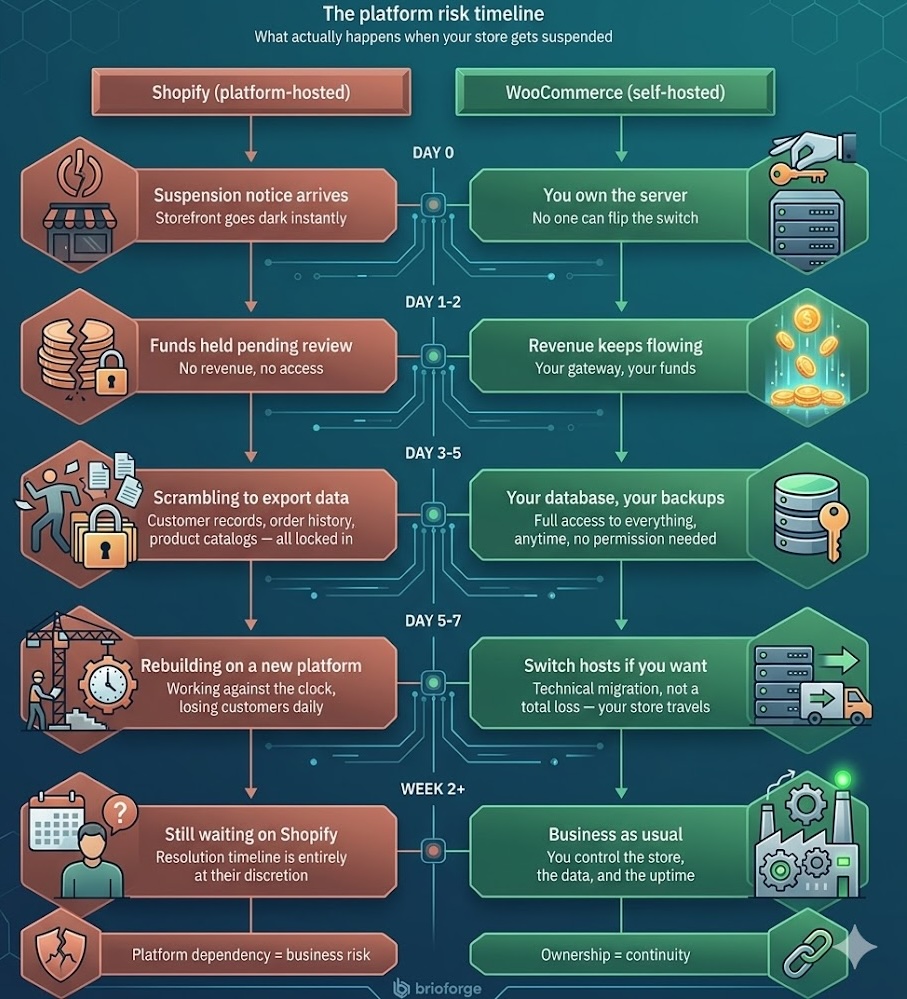
We have helped clients rebuild after Shopify suspensions, and the pattern is consistent. The suspension arrives with little warning, funds are held pending review, and the timeline for resolution is entirely at Shopify’s discretion. In the meantime your storefront is dark.
For a seasonal business or a brand mid-launch, three to seven days of downtime is not an inconvenience. It is a genuine financial hit. Because Shopify controls your store data, migrating under duress means working against the clock to extract customer records, order history, and product data in a format you can actually use.
This is the risk that does not appear on Shopify’s pricing comparison pages.
How WooCommerce Works Differently
WooCommerce is software you install on hosting you control. The database is yours. The code is yours. If you decide to move to a different hosting provider, your store comes with you. It does not live or die at the discretion of a single company’s acceptable use policy.
Three things this changes in practice:
- No platform risk. Your store can only go down if your hosting provider terminates your account or you stop paying your hosting bill. Hosting providers work with a far wider range of product categories than Shopify does, and switching hosts is a technical migration rather than a total loss.
- Payment processor choice. WooCommerce supports dozens of gateways including processors that specialise in high-risk and regulated categories. We regularly help clients integrate processors who handle CBD, supplements, firearms accessories, and alcohol. These options simply do not exist within the Shopify Payments ecosystem.
- Your compliance rules, not a platform’s interpretation of them. With WooCommerce you are responsible for legal compliance with actual regulations, meaning FDA guidelines, FTC rules, state laws, and age verification requirements. But you are not also fighting a private platform’s shifting interpretation of what content is acceptable.
The Honest Tradeoffs
Shopify is genuinely easier to start. If you are testing a new product concept at low volume, Shopify’s setup speed is a real advantage. WooCommerce requires a competent hosting setup, proper configuration, and for anything complex, real development work.
A poorly built WooCommerce site can be slower and less stable than a well-maintained Shopify store. Done right, WooCommerce is faster, more flexible, and significantly less expensive at scale. Done badly, which often happens when businesses go with the cheapest option, the problems compound.
For regulated businesses that have moved past the early validation stage, these tradeoffs almost always resolve in favour of WooCommerce. The platform risk from Shopify is simply too high once your business depends on continuous operation.
The Questions That Actually Determine Which Platform Is Right
- Is your product category on Shopify’s restricted list? Check both the Acceptable Use Policy and the Shopify Payments Terms. They are different lists and a product can appear on one and not the other.
- Can you use Shopify Payments for your product type? If not, you are already on a third-party gateway with higher fees. Is that gateway also available on WooCommerce with better terms?
- What would three days of downtime cost your business? If the answer is a lot, platform dependency is a strategic risk you need to price in.
- How important is data ownership? With Shopify, your data lives inside their system. With WooCommerce it lives in your database, and you take it with you when you leave.
- Do you need ERP integration, custom checkout flows, or specialised workflows? WooCommerce’s open architecture is a genuine advantage for operational complexity.
- Are you already on WordPress? If so, WooCommerce is the most direct path to proper eCommerce. Same infrastructure, same admin, no separate platform to manage.
| WORKING WITH BRIOFORGE Already on WordPress? WooCommerce is the natural next step, and it is what we do. Most of our clients come to us in one of three situations: they’re already on WordPress and want to sell properly without bolting on a separate platform, they’re on Shopify and running into restrictions they can’t work around, or they’ve got WooCommerce already but something isn’t working the way it should. What we don’t do is come in with a predetermined answer. We start by understanding your business. What you sell, what your constraints are, what’s actually broken versus what just feels broken. Sometimes that conversation leads to a build. Sometimes it leads to a fix. Sometimes it leads to us telling you that you don’t need as much as you think you do.If any of this sounds like where you are, we’re worth talking to. Not a sales call. A real conversation about whether we’re the right fit and what the path forward looks like. Get in touch at brioforge.com/contact. |
Frequently Asked Questions
Can I sell CBD on Shopify?
Shopify permits hemp-derived CBD products in some US states, but Shopify Payments does not support CBD transactions in most cases. You would need a third-party gateway with higher fees and sometimes lower approval rates. For businesses where CBD is a core product line, WooCommerce with a specialised processor is a more stable long-term setup.
What payment processors work for regulated products on WooCommerce?
Options vary by product category and business location, but processors who specialise in high-risk and regulated categories integrate cleanly with WooCommerce. The right processor depends on your specific product type, volume, and chargeback history. We work through this selection with every regulated client we take on.
Is WooCommerce more expensive than Shopify?
Not typically, especially at scale. WooCommerce has no transaction fees and no monthly platform fee. You pay for hosting, plugins where needed, and development. For businesses doing significant volume, or those who would need expensive Shopify add-ons anyway, WooCommerce is usually less expensive over a two to three year horizon.
I am already on WordPress. How complicated is it to add WooCommerce?
For a standard installation, WooCommerce installs like any other plugin and the core setup is relatively straightforward. What varies in complexity is the configuration around your specific product type. Payment gateway setup for regulated products, age verification, subscription handling, and ERP integration all add scope. The base install is simple; getting the commerce layer right for your business is where expertise matters.
How long does a Shopify to WooCommerce migration take?
For a well-organised store with clean data, a professional migration takes two to four weeks. For stores with complex custom features, ERP integrations, or messy historical data, plan for six to ten weeks. We always recommend migrating with sufficient runway, not after a suspension has already happened.